

The development, review, approval, and registration processes for SUNY academic programs registered by the New York State Education Department (NYSED) is a multi-stage process that involves campuses, SUNY System Administration, and either the NYSED Office of College and University Evaluation (OCUE) or the NYSED Office of the Professions (OP). For certain program types, the SUNY Board of Trustees, Board of Regents, Office of the Governor, programmatic accreditation, and/or institutional accreditation (i.e., Middle States) may also be involved.
Program development is informed by multiple entities, including the following:
Typically, the process begins on campus among the faculty, with programs developed, reviewed, and approved via local shared governance policies and procedures, which differ by campus. Once approved on campus, the program is submitted from the campus provost office to Academic Affairs in the Office of the Provost at SUNY System Administration, where it is reviewed via an iterative process with the campus. Upon approval by SUNY, the program is then submitted by SUNY to NYSED for review and registration. There exists some variability in this process based on program type and action type, with some variations involving added expectations for review and approval.
Plans for new degree programs (to be offered within New York State or at an out-of-state location whereby 50% or more of the curriculum is offered at the out-of-state location) must first be announced to other SUNY campuses prior to the development of the full program proposal. An undergraduate degree announcement is referred to as a Program Announcement (PA) and a graduate degree announcement is referred to as a Letter of Intent (LI). Although differently named, the PA and LI serve the same function.
Note: announcement is not typically required for the following program types but may be required in specialized circumstances: undergraduate certificate, graduate advanced certificate, and ‘new from existing’ program such as a new multi-award program created from existing standalone programs or disaggregating a track from an existing program to create a standalone program that mirrors the curriculum of the track. Unless otherwise informed by SUNY System Administration, campuses may proceed to the full program proposal for these program types.
The following are the steps of the announcement stage.
1. The PA/LI is developed on campus through the local shared governance process. Following campus approval, the PA/LI is submitted from the campus provost office to Academic Affairs in the Office of the Provost at SUNY System Administration.
2. Prior to announcement, academic affairs will conduct a preliminary review, engaging other offices (e.g., budget) as applicable, to verify completeness of the proposal and to address substantive matters such as fit with mission, fiscal viability, and compliance with significant policies and regulations. Academic affairs must approve the announcement of each proposal.
3. Upon announcement (which is included in the weekly Academic Programs Update typically distributed each Friday to campus Presidents, Provosts, and others who have requested to receive this update), campuses will have 10 calendar days to submit an intent to comment on the PA/LI of another campus. This intent to comment is to be sent from the commenting campus President or Provost to the proposing campus President or Provost with a cc to program.review@suny.edu.
4. If no intent to comment is received within 10 calendar days, the PA/LI is automatically approved, and the campus may immediately proceed to the full proposal stage. In these instances, a formal approval memo will not be issued for the PA/LI.
5. If a campus submits an intent to comment, they must submit the full comment within 30 calendar days of the original announcement date. This comment is to be sent from the commenting campus President or Provost to the proposing campus President or Provost with a cc to program.review@suny.edu.
6. The proposing campus President or Provost should reply within 30 days of receiving the comment, by sending a response to the commenting campus President or Provost with a cc to program.review@suny.edu.
7. It is highly encouraged for campuses to communicate directly with each other prior to sending comments that include an objection and/or as part of the process after an objection has been issued. The goal is for campuses to arrive at a mutual understanding rather than exercise objections. If the campuses are able to arrive at a mutual understanding, the proposing campus may withdraw the PA/LI or the commenting campus may withdraw the objection.
8. If the campuses are unable to arrive at a mutual understanding, SUNY System Administration will adjudicate the situation and render a decision as to whether the proposing campus may proceed. In these instances, SUNY System Administration will issue a formal decision memo.
9. Campuses are reminded of the following:
a. Comments that include an objection and responses to such comments should be accompanied by data related to the argument presented.
b. Insufficient grounds for objection include, but are not limited to, the following: unsupported claims, future intent to develop a similar program, historical prominence in the proposed program area, or a singular focus on competition for enrollment.
10. Once approved to advance to the full proposal stage, approval for an undergraduate program expires after one year and approval for a graduate program expires after two years. If the proposing campus does not submit the full program proposal to SUNY prior to the expiration date, the campus must proceed through the announcement stage again. Under special circumstances, academic affairs may grant an extension to the expiration date.
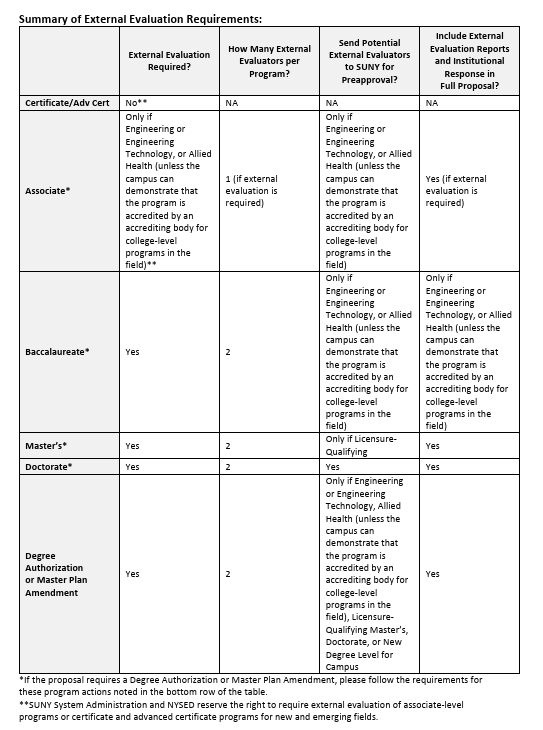
External evaluation by disciplinary experts outside of the proposing institution is a valuable part of the program development process. Below are the expectations for external evaluation.
1. Requirement: External evaluation, by one evaluator, as well as the campus response to the external evaluation, is required for the proposal of a new degree program at the associate level for Engineering or Engineering Technology or Allied Health (unless the campus can demonstrate that the program is accredited by an accrediting body for college-level programs in the field). External evaluation, by two evaluators, as well as the campus response to the external evaluation, is required for the proposal of new degree programs at the baccalaureate level or higher (note: external evaluation is typically not required for a program created through the ‘new from existing’ process, such a creating a new multi-award program from existing standalone programs or disaggregating a track from an existing program to create a standalone program that mirrors the curriculum of the track). External evaluation is also required for Master Plan Amendments and Degree Authorizations, no matter the award level.
2. Preapproval: Campuses will select external evaluators without the need for preapproval from SUNY System Administration, except in instances that require NYSED preapproval, including: undergraduate degree program in engineering or engineering technology, undergraduate degree program in an allied health area (unless the campus can demonstrate that the program is accredited by an accrediting body for college-level programs in the field), master’s degree that is licensure-qualifying, doctoral program, and program that introduces a new degree level for the campus. In these instances, campuses must obtain preapproval by submitting to Academic Affairs in the Office of the Provost at SUNY System Administration a rank-ordered list and the CVs of three to five potential evaluators and a brief rationale for their selection, which will then be transmitted by SUNY to NYSED for review and preapproval.
3. Submission of External Evaluation with Proposal: For associate or baccalaureate programs in engineering or engineering technology or an allied health area (unless the campus can demonstrate that the program is accredited by an accrediting body for college-level programs in the field), all master’s and doctoral programs, and proposals requiring a Master Plan Amendment or Degree Authorization, campuses will include with the full proposal the external evaluation reports and campus response that describes how the campus adjusted the program in response to substantive feedback in the evaluation and/or provides reasoning for why the campus did not make such adjustments to specific points of feedback. For other baccalaureate programs, campuses will include an attestation that external evaluation was conducted but will not submit the external evaluation reports or campus response as part of the full proposal.
4. Campuses are reminded to ensure the following:
a. Remote external evaluation is permissible, except in instances when in-person is necessary due to program-specific expectations related to facilities. For remote evaluations, 1. materials and remote connections with relevant stakeholders must be made readily available to external evaluators and 2. for programs that involve laboratories or other facilities, the campus must be able to provide a way for evaluators to virtually interact with these facilities in a manner that would substantially approximate an in-person visit.
b. Given SUNY’s commitments to diversity and inclusiveness, which includes the guiding principle that diversity and inclusiveness are integral components of the highest quality academic programs, campuses are expected to engage a diverse set of external evaluators.
c. All external evaluators are expected to: 1. possess significant expertise in the discipline of the proposed program, 2. have appropriate academic credentials, professional experience, and academic teaching and/or administrative experience in similar programs at peer institutions (typically, outside of the SUNY system), and 3. not have a conflict of interest or the appearance of a conflict of interest with the institution or program (e.g., current or prior relationship with the institution as a student, employee, or substantially involved party such as a research collaborator).
d. For licensure-qualifying programs, at least one of the evaluators should be licensed in New York State in the proposed licensure area.
e. For educator preparation programs, at least one of the evaluators should be from an institution in New York State that offers a registered program in the proposed certification area.
f. For doctoral programs, both evaluators should be from outside of New York State and should have administrative/leadership experience within a doctoral program.
g. For a new degree level, the evaluation team must be able to evaluate institutional readiness, not just the academic program, in the following areas: mission, institutional commitment, and long-range planning; academic governance and administration; financial resources, facilities, and equipment; library and information resources; faculty; curricula, academic standards, and assessment; admissions; and academic and support services
Each academic program is assigned two classification (taxonomy) codes, HEGIS and CIP, which are utilized for various purposes, such as reporting and analyzing student enrollment in identified fields and determining financial aid eligibility.
Within a program proposal, a campus must propose a code for both HEGIS and CIP, both of which will be assessed during the review process. The bases for code assignment are the program curriculum and the program learning outcomes.
1. HEGIS
a. The HEGIS code must be approved by both SUNY System Administration and NYSED.
b. HEGIS codes are organized into ten (10) disciplinary areas: Agriculture, Biological Sciences, Business, Education, Engineering, Fine Arts, Health Professions, Humanities, Physical Sciences, Social Sciences.
c. There do not exist detailed descriptions of the HEGIS codes; therefore, campuses should propose the best fit based on the titles of the available codes and the code assigned to like programs within the campus and/or at other campuses throughout New York State (HEGIS codes are displayed in NYSED’s public-facing Inventory of Registered Programs and for SUNY programs are also available within the Business Intelligence dashboards).
d. HEGIS codes are six digits in length and are written with four preceding the decimal and two following the decimal.
e. Associate degree programs are assigned a HEGIS code in the five-thousand range (e.g., in the Health Professions, an associate level nursing program would be assigned 5208.XX whereas a baccalaureate level nursing program would be assigned 1203.XX).
f. Certificate and Advanced Certificate programs’ HEGIS codes should be consistent with the degree program(s) to which their credits are applicable.
2. CIP
a. The CIP code must be approved by SUNY System Administration.
b. CIP codes are updated every ten years and the current codes are from 2020; therefore, CIP 2020 codes are to be used rather than an older code used prior to 2020.
c. There is a definition provided for each CIP code and campuses should propose the best fit based on the definition provided. Additionally, consideration should be given for the code assigned to like programs within the campus and/or at other SUNY campuses (CIP codes for SUNY programs are available within the Business Intelligence dashboards).
d. CIP codes are six digits in length and are written with two digits preceding the decimal and four digits following the decimal.
e. Generally, there are no limitations for assigning CIP codes based on award level (e.g., associate vs. baccalaureate) or award type (e.g., certificate vs. degree) but instead the determining factor in assigning a CIP code is how the program design aligns with the CIP definition.
For degree programs, a full program proposal must be submitted from the campus provost office to Academic Affairs in the Office of the Provost at SUNY System Administration prior to the expiration date of the PA/LI. For certificate programs or ‘new from existing’ degree programs that have no PA/LI stage, a full program proposal can be submitted at any time. The assigned SUNY Campus Reviewer will review the proposal via an iterative process with the campus, and as needed, include other offices (e.g., budget). Focal points of the review include, but are not limited to, SUNY policies and priorities, NYSED regulations (e.g., 3.47, 3.50, 50.1, 52.1, 52.2, and 54.0) campus and SUNY mission, program quality, program need, and fiscal viability informed by enrollment trends in similar existing programs, labor market data, and new resources needed to offer the program, such as costs associated with new faulty/staff and new equipment/facilities. There exists some variability in this process, and areas of focus, based on program type, with some variations involving added expectations for review and approval. If a Degree Authorization or Master Plan Amendment is needed, please refer to the section of this guide regarding these expectations.
After the proposal is deemed approvable, SUNY will advance it to the applicable NYSED office that will review and register the program. The Office of the Professions (OP) reviews and registers licensure-qualifying programs and programs deemed to be ‘licensure adjacent’ such as associate degree programs in accounting and graduate programs in engineering. The Office of College and University Evaluation (OCUE) reviews non-licensure programs and programs that lead to a P-12 educator certificate title.
During the NYSED review, NYSED associates may have additional feedback for the campus, which they should send to the campus (typically the provost and/or designated contact for the proposal), copied to program.review@suny.edu and the SUNY Campus Reviewer. If the NYSED associate did not copy either program.review@suny.edu or the SUNY Campus Reviewer, the campus should forward the correspondence so that SUNY can maintain complete and accurate records and can assist the campus in responding to NYSED, if necessary. When the campus responds to NYSED, the campus should send its response to the NYSED associate, program.review@suny.edu, and the SUNY Campus Reviewer.
When NYSED registers a program, the registration correspondence is sent to the SUNY Provost, copied to the campus president and provost, and the SUNY Campus Reviewer. Additionally, the program is added to the NYSED Inventory of Registered Programs, which is a public listing of all registered programs for campuses throughout New York State.
Importantly, campuses may not advertise, recruit for, or admit students to a program until after it is registered.
In addition to the above, the following provides specialize information for particular program types.
Educator Preparation Programs: NYSED reviews all Educator Preparation Programs (EPPs) based on requirements in Part 52.21 of the Regulations of the Commissioner of Education, which can be found at https://www.nysed.gov/college-university-evaluation/education-law-rules-and-regulations. Additional information about the Core Requirements for Teacher Preparation Programs can be found at https://www.nysed.gov/college-university-evaluation/core-requirements-teacher-preparation-programs.
Licensure-Qualifying Programs: NYSED reviews all Licensure-Qualifying (LQ) programs based on the applicable section of Part 52 of the Regulations of the Commissioner of Education, which can be found within the Laws, Rules, and Regulations section of each licensed profession available at http://www.op.nysed.gov/prof/. Additionally, for certain licensure areas as determined by NYSED, curricular expectations, and the required addendum to be included with a full program proposal, can be found at https://system.suny.edu/academic-affairs/acaproplan/app/kuali/.
Certificates and Advanced Certificates: Typically, proposals for new certificates and advanced certificates will be reviewed by SUNY only for program title and classification codes (HEGIS and CIP) and, if approvable, the full proposal will subsequently be transmitted to NYSED for registration review. For these proposals, campuses are reminded to ensure the following:
All credits in the certificate or advanced certificate are applicable to a registered degree program offered by the proposing campus.
Campuses are expected to review their academic program portfolio and revise programs as needed. Some revisions may occur fully through campus action, but others require SUNY approval and NYSED registration.
The following revisions require submission of a revision proposal from the campus provost office to Academic Affairs in the Office of the Provost at SUNY System Administration for SUNY review and approval, and subsequent NYSED registration of the proposed revision prior to implementing the intended change.
Placeholder Program: If students are enrolled in program to be revised, the campus must provide these students the opportunity to complete the program as previously registered (unless law, regulation, or policy requires all students to meet the expectations of the revised program or if financial exigency renders this not possible for a discontinued program). If the proposed revision impacts the way the program appears in the Inventory of Registered Programs (e.g., change in title or award) or the curricular requirements for licensure or certification, a placeholder program may be established for existing students. Placeholder programs are registered temporarily and at the time of registration are assigned a to-be-terminated (TBT) date, which is the date by which all previously enrolled students must complete the program. The campus cannot confer an award after the TBT date; therefore, selection of this date should provide sufficient time for students to complete.
Branch Campus: Proposing to establish an existing program at a branch campus is not a revision; but instead, this would require proposal of a new program at the branch campus, which may require a Degree Authorization or Master Plan Amendment for the branch campus if the branch campus currently lacks authorization for the specific degree or disciplinary area, irrespective of the approval status at the main campus.
Each campus is authorized to offer academic programs established through their mission and as registered by NYSED. If a campus has interest to expand its authorization, additional steps are required and depend on the specific program of interest.
Degree Authorization: A Degree Authorization (DA) is required if the campus has authority to award the degree level in the HEGIS disciplinary category but has not previously been granted the authority to award the specific proposed degree. No additional forms are required for a DA, but there are additional approval steps required: the SUNY Board of Trustees must approve transmission of the proposal to NYSED and the New York State Board of Regents must approve the authority for the campus to award the degree. The reviewer in Academic Affairs assigned to the campus will guide the campus through the process.
Master Plan Amendment: A Master Plan Amendment (MPA) is required if the campus seeks to expand its academic mission, which includes the following:
An MPA requires the completion of the MPA Supplement in addition to the proposal form and this document must be uploaded within the application. An MPA also requires additional approval steps: the SUNY Board of Trustees must approve transmission of the proposal to NYSED, NYSED will conduct a canvass of other potentially impacted campuses in New York State who will have an opportunity to provide comment and request a hearing, the New York State Board of Regents must approve the authority for the campus to expand its mission, and the Governor must also approve the authority for the campus to expand its mission.
There exists a limited exception to the requirement for an MPA. An institution authorized to confer baccalaureate and master’s degrees and offering registered baccalaureate programs in a HEGIS subject field (4-digit level) within one of the ten disciplinary areas (see above) may register a master’s degree program in the same subject field without approval of a master plan amendment, even if it would be the institution’s first master’s degree program in the disciplinary area. Subsequent registration of additional master’s degree programs in the disciplinary area would not need master plan amendment approval. For example, if an institution authorized to confer master’s degrees offers a registered baccalaureate program in zoology (HEGIS 0407) and wishes to offer a master’s degree program in the same subject field, zoology, the only action needed would be registration, even if the program would be its first master’s degree program in the Biological Sciences disciplinary area.
For more information, refer to NYSED guidance: https://www.nysed.gov/college-university-evaluation/proposals-requiring-master-plan-amendment. The reviewer in Academic Affairs assigned to the campus will guide the campus through the process.
New Degree Level: This is a specialized MPA required when proposing to offer a degree at a new level for the campus (e.g., first doctoral program). In addition to the MPA Supplement noted above, the campus must complete the New Degree Level – Self Study and have conducted the New Degree Level – External Evaluation, both of which are to be submitted as an addendum to full program proposal and MPA Supplement. For more information, refer to NYSED guidance: new level of study.
Off-campus instruction for courses in a registered program and programs in their entirety is governed by NYSED regulation and SUNY policy, as well as accreditation policies (e.g., Middle States policy for Substantive Change).
Locations in New York State
Instruction offered at an off-campus location in New York State is governed by Part 54 of the Regulations of the Commissioner of Education and by SUNY policy.
Extension Site (or Interinstitutional Site)
When any concerns expressed by other campuses cannot be resolved by the parties, the concerns may be brought to the attention of the SUNY Provost at program.review@suny.edu.
Extension Center (or Interinstitutional Center)
Branch Campus (or Interinstitutional Program)
Exceptions to the above include instruction in the following locations:
Locations Outside of New York State
Credit-bearing instruction offered outside New York State by SUNY campuses – whether in other U.S. states or territories, or in other nations – is governed by SUNY policy. This policy does not apply to study abroad programs that are already approved by SUNY, to articulation agreements with domestic institutions where no SUNY credit is delivered at the out-of-state location, or to academic programs registered in New York State that are delivered entirely by distance education to individual students who are not enrolled as part of an out-of-state or international partnership agreement.
For detailed information, please refer to the SUNY policy; however, the following indicates what is needed based on the proposed curricular arrangement.
-935x68.png) Additional Resources
Additional ResourcesCheck out additional information related to Academic Program Planning Procedures in the sections below.
The following links are to templates referenced in the online form that a campus may need in order to complete and submit a form. To complete a Word template, download as a Word document, edit as needed, and then save as a PDF for upload into Kuali. To complete a Program Schedule Excel template, download as a Excel workbook, edit as needed, and then save as an Excel file for upload into Kuali.